%201.avif)


What Are Call Options? A Complete Beginner’s Guide in 2025
.png)
Taylor Drake
.png)
December 12,2025
.png)
15mins read
You bought Tesla calls yesterday. Tesla jumped 4% overnight. You’re excited to check your account, expecting solid profits. Instead, your contracts are down 15%.
Sound familiar? This scenario plays out thousands of times daily because most traders understand what call options are but miss the critical forces that actually drive their prices. The difference between profitable call options trading and expensive lessons lies in understanding market structure – where dominant positioning sits and how that positioning creates opportunities.
A call option gives you the right, but not the obligation, to buy 100 shares of stock at a specific price (strike price) until a specific date (expiration). Unlike buying stock outright, call options require less capital while providing leveraged exposure to upward price movement.
Here’s what happened with those Tesla calls:
You bought them when volatility was elevated and market positioning was already stretched (to the upside). When Tesla moved up 4%, the options market had already priced in a bigger move. Meanwhile, large traders started taking profits at exactly the level you expected to break out.
This isn’t bad luck – it’s predictable market structure that most retail traders can’t see (and don’t know exists).
Most traders pick call options by:
Instead of guessing, you can see exactly:
Let’s walk through how this works, starting with the call option mechanics you need to understand.
Think of a call option as a leveraged bet with built-in insurance. When you buy a call, you’re paying a premium for the right to benefit from upward stock movement while limiting your downside to what you paid, as opposed to trading the underlying stock where you could experience losses as the stock goes all the way to $0 (if you hold that long).
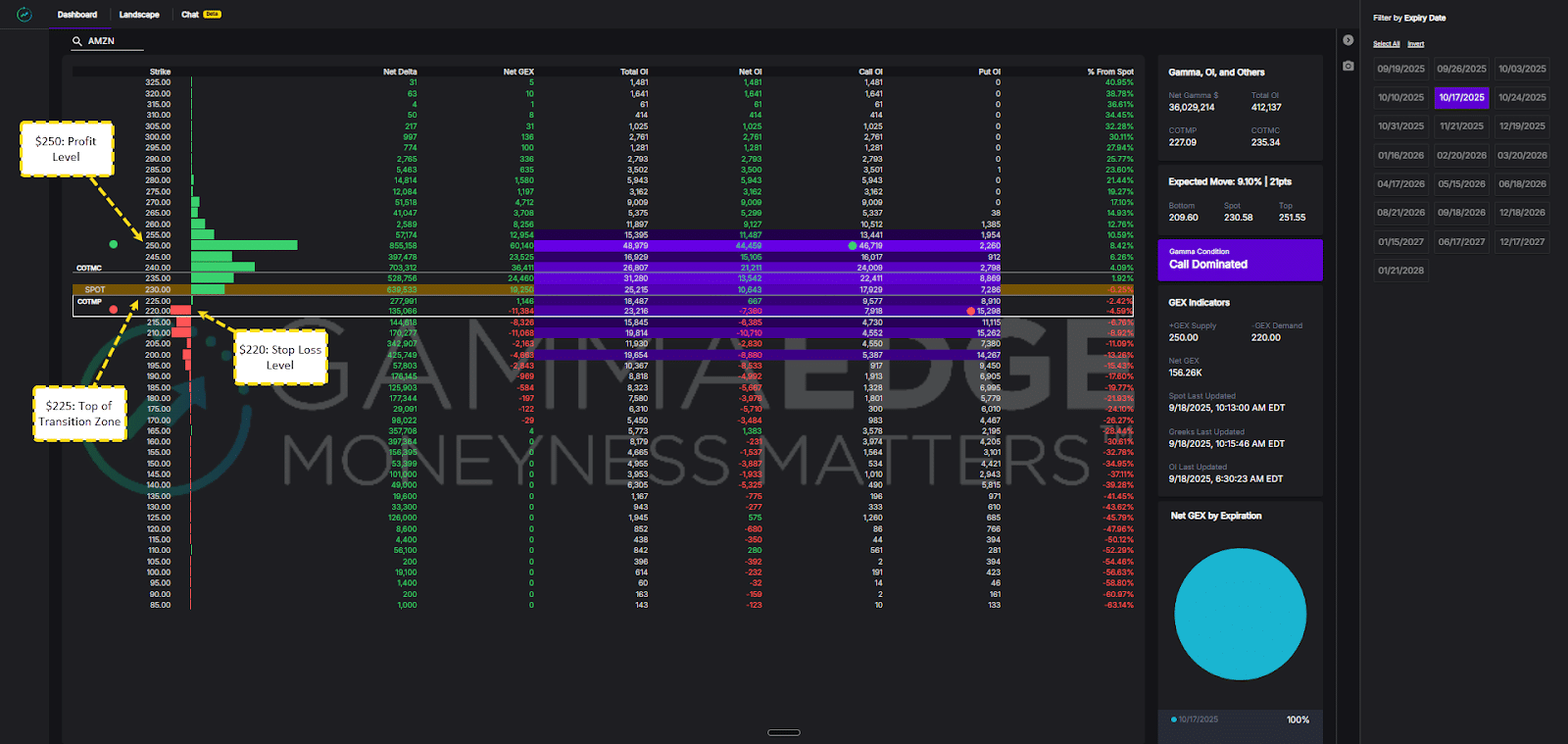
Here’s a Real Trading Example: Using our Dashboard below, which is a visualization of AMZN’s options market structure, we can see significant upside positioning is at $250 via that strike being +GEX and COI (key upside GammaEdge levels), which will serve as our profit target. $220 is the bottom of the GammaEdge Transition Zone, which will serve as our stop loss level. Your choices for trade execution are:
Stock Purchase: Buy 100 shares for ~$23,000
Call Option: Buy $240 calls for $3.95 ($395 per contract)
The call option gives you similar profit potential (if you buy 3 contracts so your total risk is roughly the same [i.e., $1000]) with 95% less capital at risk.
A Note About Selling Options: While this article focuses on buying call options, it’s worth noting that options can also be sold to collect premium income. Selling options involves different risks and strategies that we’ll cover in a dedicated guide. For beginners, focus on mastering the buying side first.
But Here’s What Most Services Don’t Tell You
The success of that Apple call option depends heavily on factors invisible in traditional analysis:
Understanding these factors transforms call option trading from speculation into strategic positioning.
Every call option’s price responds to forces most traders never see. GammaEdge’s market structure analysis reveals exactly how these work:
The Problem: You can’t see where the big money is positioned in traditional price charts.
GammaEdge Solution: Our Web App Dashboard (as shown in the Amazon example above) allows you to look under the market’s hood, revealing to you exactly where significant call buying (via institutional and retail activity) is concentrated. When you see heavy positioning at specific strikes, you’re identifying where smart money expects movement.
Practical Application: Instead of buying the $275 AMZN calls in our example hoping for a big move, market structure revealed to us that the collective options speculation was positioned for a move to $250, which influenced our selection of the $240 calls.
The Problem: Sentiment can shift rapidly, turning winning positions into losers overnight.
GammaEdge Solution: The GEX Ratio tracks whether call speculation is increasing or decreasing over time. A rising ratio often precedes strong moves, giving you early warning of building momentum (and a deteriorating ratio oftentimes show us a weakening structure in advance of price declining).
Practical Application: Before buying those Amazon calls, you’d check if call sentiment is building (favorable for your trade) or if it’s been declining (suggesting your timing might be off).
The Problem: Not all price levels are created equal – some act like launch pads for call options while others create resistance.
GammaEdge Solution: Our transition zone analysis identifies where call options are most likely to accelerate in value. These aren’t arbitrary technical levels – they’re mathematically derived from options positioning itself.
Practical Application: Rather than guessing where Amazon might break out, you’d know that $225 is a key transition level where dealer hedging could amplify your call option’s value if breached to the upside.
Here’s how to implement this systematic approach:
Traditional Method: “Amazon looks bullish on the chart, I’ll buy calls.”
GammaEdge Method:
Action Item: Never buy call options without confirming alignment from the options market and what’s happening under the hood. If the structure shows put dominance or mixed signals, either wait or consider a different approach.
Traditional Method: Pick strikes based on price or arbitrary percentages out-of-the-money.
GammaEdge Method:
Specific Example: If Amazon’s +GEX sits at $250 with strong call positioning, your $240 calls have structural backing versus random $275 or $300 strikes.
Traditional Method: Enter based on chart breakouts or momentum indicators.
GammaEdge Method: While entering with a breakout is a good start, we can amplify this by:
Pro Tip: Understanding what’s “priced in” to your call options is crucial for success. Every option has implied volatility – essentially the market’s expectation of how much the stock will move during your option’s lifetime. When implied volatility is high, the option is expensive because traders expect big moves. This means you need larger stock movements just to break even. The best call option opportunities often occur when market structure is supportive but implied volatility hasn’t spiked yet – giving you favorable positioning before the crowd recognizes the setup.
Traditional Method: Hope the stock moves in your favor and try to time the exit.
GammaEdge Method:
Exit Triggers: Take profits when your calls reach structural resistance levels or if sentiment analysis shows weakening call speculator support.
Your strike choice should match both your conviction level and what market structure tells you: But before choosing between ITM, ATM, and OTM calls, you need to understand what drives an option’s price:
Your strike choice determines how much of each component you’re buying and how your option will behave:
When to Use In-the-Money (ITM) Calls
Trade-off: Higher cost but more predictable behavior and less time decay risk
When to Use At-the-Money (ATM) Calls
Trade-off: Middle ground on cost, leverage, and probability
When to Use Out-of-the-Money (OTM) Calls
The Key Insight: ITM calls are for steady grinders, OTM calls are for explosive moves, and ATM calls balance both approaches.
Once you understand the basics of call options, GammaEdge tools unlock advanced strategies:
Uncover how to spot when significant institutional and retail call buying is building before it shows up in price action. This early positioning often precedes the strongest moves. This is best seen through our GEX Ratio tool.
As options are inherently forward looking, we can use our Delta Balance to see how call positioning evolves across different expiration cycles. Strong alignment across timeframes signals higher probability setups.
Leverage structural levels to set logical stop losses and profit targets based on where market forces will likely create support or resistance.
This Week’s Action Items:
Free Resources to Get Started:
This way of thinking may be new for folks. That’s exactly why we created our flagship educational course called the GammaEdge FastPass, which is designed to significantly accelerate your learning curve. As with all of our education, it’s completely free to you and gives you everything a paid member of our community gets. That includes our methodologies, our strategies, frameworks, etc. We hold nothing back. You can unlock your copy of the FastPass using the link below: