%201.avif)


The Wheel Strategy: Options Trading Complete Guide 2025
.png)
Taylor DrakeTaylor Drake
.png)
December 12,2025
.png)
15mins read
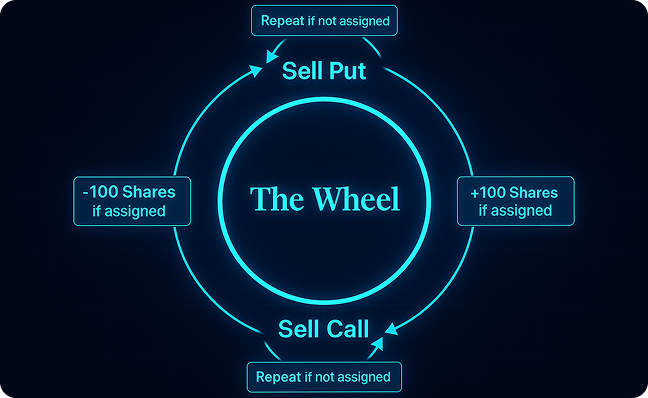
The wheel options strategy is a systematic income-generating approach that involves selling cash-secured puts to acquire stocks at lower prices, potentially, and then selling covered calls on the assigned shares to generate additional income. This cyclical process—selling puts, accepting assignment, selling calls, and repeating—creates a “wheel” of premium collection while building stock positions at favorable prices.
Here’s a scenario you’ve likely encountered (or heard about) before: You sold a cash-secured put last month with a strike price of $50. Sure enough, the stock dropped, and you got assigned at $50; now you’re holding shares with spot price at $45. You sell a covered call at your $50 breakeven point, collect $75 in premium, and wait for the recovery.
Three weeks later, the stock hits $48.
Your call expires worthless.
You sell another call at the $50-strike. Then another for $40.
Six months pass. You’ve collected a total of $200 in premiums, reducing your cost basis to $48. But you’re still stuck underwater in a losing position that’s tying up $5,000 in capital—and the stock shows no signs of breaking out.
This is the hidden cost of traditional wheel strategies—and it plays out repeatedly. What if there was a better way?
Here’s what happened: You picked a stock that looked promising on the chart—maybe it was consolidating nicely, or perhaps you had heard about it on CNBC. You sold a 20-delta put 45 days out because that’s what the internet said to do.
But here’s the problem: That entire approach is based on legacy market dynamics. Today’s markets work differently.
Here’s what’s changed: Options market positioning now DRIVES stock price movement, which means the stocks you select and the strikes you choose aren’t just important—they determine whether you’re trading with market structure or fighting against it.
Traditional wheel strategies ignore this entirely.
Your stock passed the basic technical screen. But underneath the surface, options positioning told a different story. That key bit of information may have prevented the stock assignment and valuable capital tied up for an extended period of time.
The Traditional Approach Falls Short
Most traders run the wheel by:
The GammaEdge Advantage: Instead of trading blind, our framework provides:
The result?
And all of this is systematically identified for you through GammaEdge’s framework, which, as you will see by the end of this article, is superior to hoping market conditions remain favorable.
Let’s start by understanding how the traditional wheel actually works—then we’ll reveal exactly how GammaEdge transforms each step from guesswork into measurable, systematic edge.
um dolor sit amet, consectetur adipiscing elit. Ut elit tellus, luctus nec ullamcorper mattis, pulvinar dapibus leo.
The wheel strategy derives its name from its cyclical nature—much like a wheel that keeps turning, the process repeats indefinitely. Here’s how each phase works:
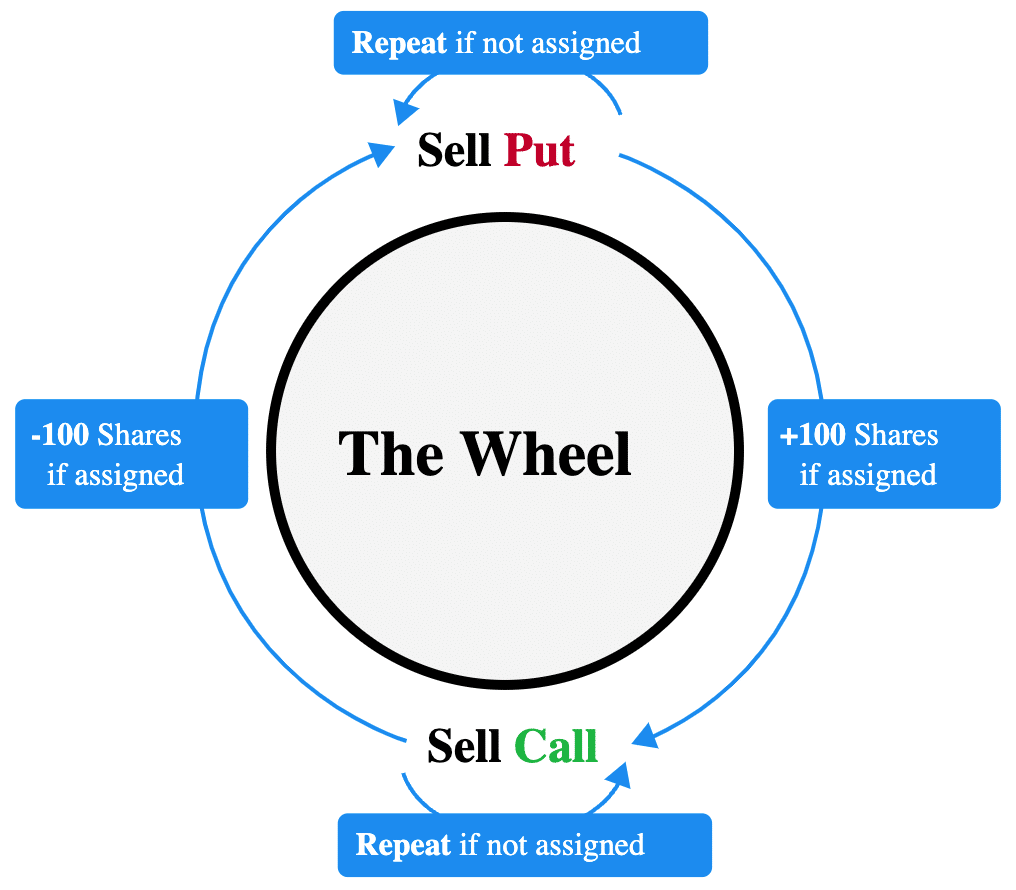
You start by selling a put option on a stock you wouldn’t mind owning. When you sell this put, you’re agreeing to buy 100 shares at a specific price (the strike price) if the stock falls to that level (or lower) by expiration.
Outcome A: Put Expires Worthless (Stock Stays Above Strike)
Outcome B: Assignment (Stock Drops Below Strike)
Once you own the shares, you enter the second leg of the wheel—selling covered calls.
What you receive: Another premium payment for selling the call. This premium further reduces your effective cost basis on the shares (the premium from the sold put plus the premium from the sold call).
Scenario A: Shares Get Called Away (Stock Rises Above Strike)
Scenario B: Call Expires Worthless (Stock Stays Below Strike)
The wheel’s appeal is straightforward:
But here’s what traditional wheel guides won’t tell you: The stocks you choose and when you choose them determine everything. Two traders running the same wheel mechanics can achieve completely different results, based solely on the stocks they select and the underlying options market structure when they enter.
That’s where most wheel strategies break down—and where GammaEdge’s framework creates systematic edge.
Let’s examine what traditional approaches are lacking in today’s markets.
Traditional wheel strategies operate on a simple premise: sell premium, own good stocks, repeat. However, this approach was designed for markets that have undergone fundamental changes.
Your stock selection and timing aren’t just important—they determine whether you’re trading with these structural forces or fighting against them. Let’s break down the three forces traditional wheel strategies ignore entirely:
Practical Application: Instead of selling puts on any stock with a decent technical setup, you target stocks where GammaEdge scanners show a call-dominated structure with expanding delta. You’re aligning with significant bullish options activity, not hoping it materializes.
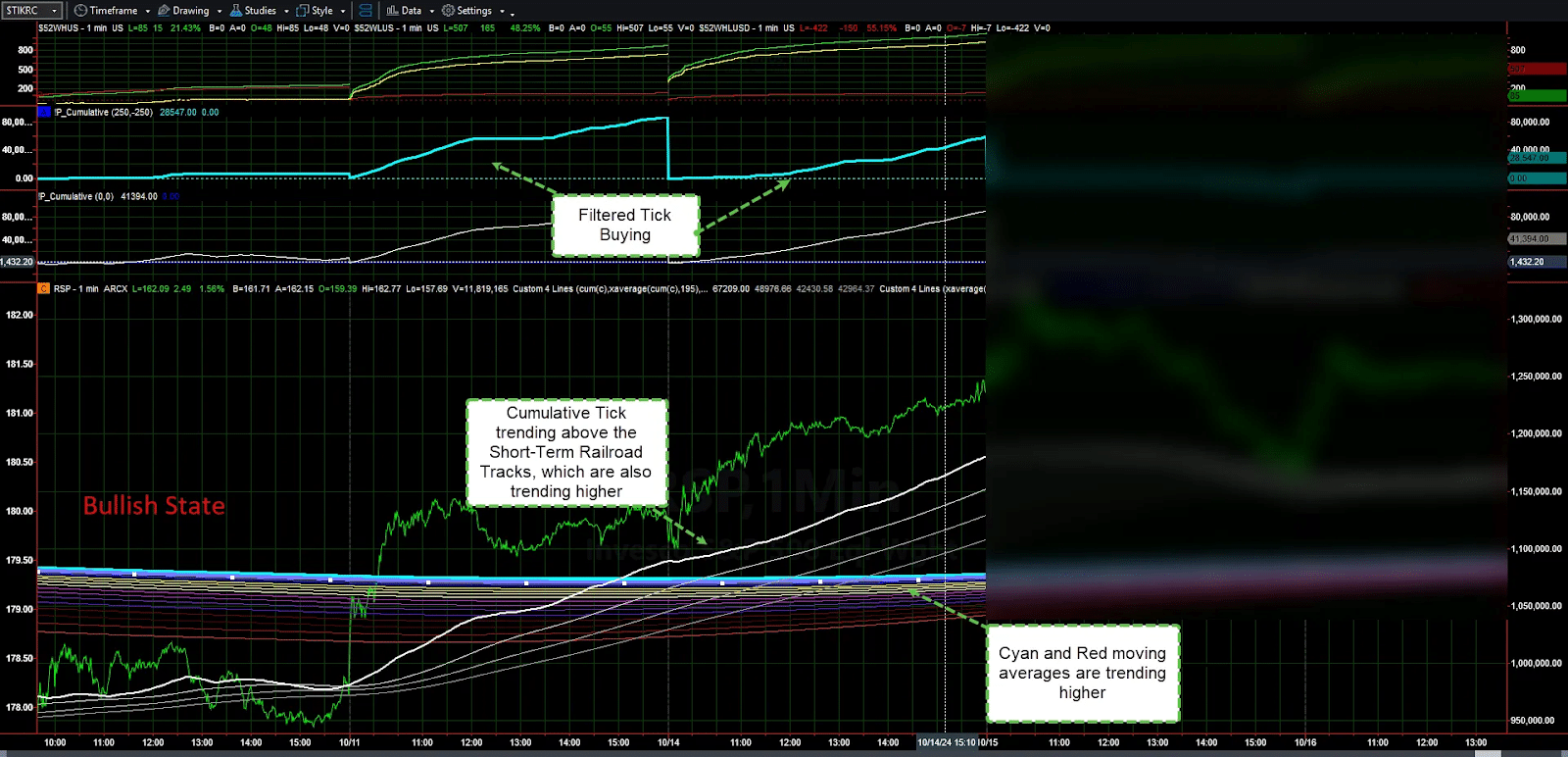
…rather than environments that look like this, when TC3+ is turned off, indicating to us that markets are weak/weakening:
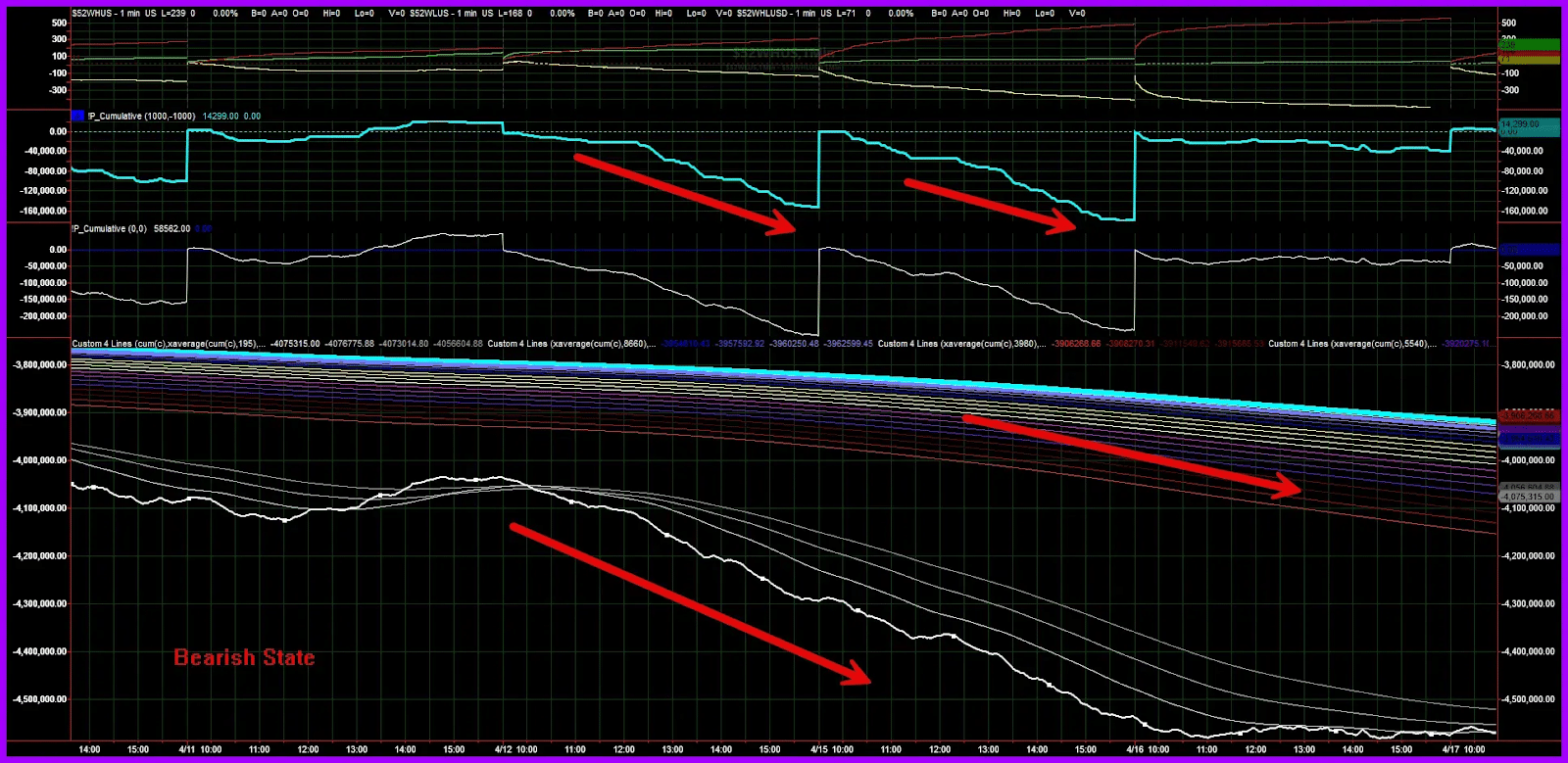
Practical Application: Before selling any put, you verify both the GammaEdge scanner appearance AND a high Minervini score. This means assignments occur only on high-quality stocks where recovery is statistically probable—not hope-based holdings.
Understanding each force individually is valuable, but what makes this framework powerful is that these three forces stack the edges in your favor.
When you sell puts on stocks showing:
You’re not just improving your odds incrementally—you’re creating a multi-layered statistical edge where each filter compounds the effects of the others. This is why GammaEdge Wheel traders achieve a win rate of over 80%, higher net gains, and lower intra-trade drawdown. At the same time, traditional approaches tend to yield variable results with lower net gains, deeper intra-trade drawdown, and significantly higher assignment rates.
The difference isn’t luck or market timing. It provides visibility into forces that drive outcomes but remain invisible to traditional analysis.
Traditional wheel strategies leave you guessing. The GammaEdge Wheel Strategy eliminates guesswork through a three-phase systematic approach that aligns every decision with measurable market structure.
Here’s how it works:
Unlike traditional approaches that sell puts on any decent-looking stock, GammaEdge uses multi-layer filtering to identify only the highest-probability opportunities.
And don’t worry—we’ll show you how GammaEdge automates this entire qualification process in just a moment.
The Three-Gate Qualification System:
Gate 1: Market Timing (TC3+ Bullish Signal)
Gate 2: Institutional Positioning (GammaEdge Scanners)
By showing up on one of these four scans, these stocks are displaying the following bullish characteristics:
Gate 3: Technical Momentum (High Minervini Scoring)
Strike Selection Strategy:
Once a stock qualifies, target strikes with:
The GammaEdge Advantage: Traditional approaches use 30-45 day expirations at fixed deltas. We use a 1-2 week duration on systematically qualified stocks. This results in faster capital turnover and reduced exposure to deteriorating fundamentals.
Critical Insight: If you’re thinking “this sounds like a lot of work to screen every stock,” here’s the relief: All of this analysis is automatically done for you through GammaEdge’s suite of scanners. Every day, our system processes hundreds of optionable stocks through these exact filters—TC3+ signal, options market positioning, Minervini scoring—and delivers only the qualified opportunities directly to you. What would take hours of manual analysis per stock happens instantly. You focus on execution; we handle the systematic edge identification.
Position Management:
Here’s where traditional wheels break down—and where GammaEdge creates separation.
Basis Reduction Strategy:
Instead of hoping that the stock recovers, actively reduce your cost basis:
GammaEdge Advantage: Traditional traders pick arbitrary lower strikes and hope. We target specific structural levels where options positioning reveals natural support zones. Basis reduction becomes systematic rather than random.
Critical Note: Basis reduction CSPs ignore TC3+ signal requirements—you’re managing an existing position, not initiating new risk.
Covered Call Execution:
The Wheel Completes:
Traditional Wheel Reality:
GammaEdge Wheel Performance:
The Key Insight: Every decision—from stock selection to strike choice to assignment management—is driven by observable market structure rather than hope, gut feeling, or arbitrary rules.
You’re not running a wheel strategy. You’re executing a systematic framework where institutional positioning, technical momentum, and macro timing align in your favor.
You understand the framework. GammaEdge delivers the qualified opportunities. Now let’s focus on execution refinements that separate good results from exceptional ones.
Traditional wheel strategies use arbitrary position sizing—”I’ll sell 5 contracts because I have $25K” or “one contract per opportunity.” GammaEdge uses expectancy-driven sizing (based on your performance) that creates a self-improving feedback loop.
How It Works:
Practical Example: If your average profit is $85 per trade (running expectancy), then $85 is your minimum acceptable premium.
Here is another simple three-trade example:

The system tells you how big to go, not the amount of available capital or your gut feeling.
Why This Creates Edge:
Here’s a reality check: You don’t need to be fully deployed to be successful with this strategy.
Traditional wheel traders feel pressure to keep all their capital working, which leads to forcing trades on mediocre setups. The GammaEdge approach flips this thinking—your edge comes from selectivity, not activity.
The key insight? Quality opportunities come in waves. Some weeks, you’ll find 10 qualified setups. Other weeks you’ll find zero. The system isn’t broken during dry spells—it’s protecting you from suboptimal trades.
Here’s something that trips up new traders: You sell a put on Tuesday because the stock appeared on scanners. Wednesday morning, you check—and it’s no longer in the scanner results. Did something break? Should you exit?
Neither. This is entirely normal.
The $ncalldomdel, $ncalldomcha, and $newrhpbulldb scanners we use show NEW dominance changes. They’re designed to catch institutional activity as it’s building, which usually means they only flag stocks for a single day. The $allcalldom scanner might show stocks for days or weeks, but even that will cycle.
You need to monitor specific metrics, but don’t turn this into a full-time data analysis job.
The goal isn’t to micromanage every trade. It’s to spot when your execution might be drifting from the systematic approach. If your win rate drops to 70%, that’s information. Are you compromising on qualification criteria? Getting impatient during opportunity droughts? The metrics tell the story.
Assignments happen. Even with >80% OTM probability trades, you’ll eventually get assigned. Remember what this means: You now own a stock that scored very high on the Minervini’s momentum criteria. That’s institutional-quality positioning. The stock didn’t suddenly become garbage—it’s just temporarily below your strike.
Follow the basis reduction protocols systematically. Use the -Trans and -GEX levels from GammaEdge (available through Discord commands or the WebApp) to target your next CSP strikes. These aren’t arbitrary lower prices—they’re structural support zones where options positioning reveals natural dealer pressure. Be patient. Quality stocks recover; poor stocks languish. This is why the qualification gates matter.
Multiple simultaneous assignments are rare (remember that the <10% assignment rate), but if it happens, you’ve got a clear playbook. Prioritize basis reduction over hunting new opportunities. Redirect available capital toward assignment management. The system handles this scenario—you just need to execute the protocols without panic.
Extended droughts without qualified opportunities actually demonstrate the system working correctly. When market structure deteriorates, fewer stocks will pass through all three gates. This is selectivity protecting your capital, not the strategy failing. Keep uninvested funds in high-yield savings and stay patient. Opportunity clusters return when structure shifts—and you’ll be ready with fresh capital and clear protocols.
Here’s what happens over time with this approach: Your expectancy rises as you execute quality trades. Rising expectancy makes your standards more stringent. Stricter standards mean you only take the strongest setups. Stronger setups produce better outcomes. Better outcomes raise your expectancy further.
It’s a self-reinforcing cycle where success literally raises the bar for future trades. You’re not working harder—you’re letting the systematic edge compound through disciplined execution.
Traditional wheel traders grind through dozens of mediocre trades, hoping for consistency. GammaEdge Wheel traders wait for qualified setups where multiple structural advantages align, then execute with precision—same time investment, dramatically different results.
Do I need to manually calculate Minervini scores for every stock?
No. GammaEdge scanners automatically filter for stocks meeting the necessary Minervini momentum criteria (along with options market positioning assessment). You receive pre-qualified opportunities—the systematic analysis is already done.
What broker requirements do I need?
You’ll need options trading approval (Level 2 minimum) with the ability to trade cash-secured puts and covered calls. Your broker must support Good-Til-Canceled (GTC) orders for the automated 10% exit strategy. Most major brokers (TD Ameritrade, Interactive Brokers, E*TRADE, TastyTrade, etc.) meet these requirements.
What's the minimum capital needed to run this strategy?
There’s no fixed minimum, but consider that each CSP requires capital equal to 100 shares at the strike price. A $50 strike requires $5,000 in cash-secured capital. The strategy works with single contracts, so smaller accounts can participate. Target 7+ positions for proper diversification when capital allows, but you can start with fewer positions while building.
How much time does this require daily?
Expect 10-20 minutes daily during market hours or after close. Check TC3+ signal status, review GammaEdge scanner results for qualified opportunities, execute any new positions, and monitor existing positions. Weekly reviews add another 20-30 minutes for expectancy updates and assignment management checks.
Is this strategy suitable for retirement accounts?
Yes, CSPs and covered calls are generally allowed in retirement accounts. Check with your broker for specific requirements and restrictions.
Why 1-2 weeks to expiration instead of the traditional 30-45 days?
Shorter duration creates three advantages:
The high-probability strike selection (>68% OTM) works even better with compressed timeframes.
What happens if the TC3+ momentum signal turns "False" while I'm holding positions?
Continue managing existing positions according to standard protocols, including 10% BTC orders, assignment management, and basis reduction as needed. TC3+ only gates NEW position entries, not the management of positions you’ve already entered. This prevents adding to risk during unfavorable conditions while letting existing high-probability trades play out.
The stock I entered appeared on scanners yesterday but disappeared today. What do I do?
Nothing. This is entirely normal. The $ncalldomdel, $ncalldomcha, and $newrhpbulldb scanners show NEW dominance changes and typically persist for only one day. Once you’ve qualified a stock and entered a position, scanner status changes are irrelevant. Follow your established management protocols—the 10% BTC exit will automatically handle profitable closes.
Yes, CSPs and covered calls are generally allowed in retirement accounts. Check with your broker for specific requirements and restrictions.
How do I know where to place basis reduction CSPs?
Use GammaEdge’s proprietary -Trans (transition zone) or -GEX levels for the specific stock. Access these through Discord commands (like $s aapl) or the GammaEdge WebApp. These levels represent areas where put-dominated structure exists and dealer selling pressure naturally concentrates—making them optimal support zones for additional put selling.
Should I ever roll a losing CSP position?
Never. The GammaEdge Wheel accepts assignment on quality stocks rather than rolling. Rolling converts small losses into large “boat anchor” positions that drag down returns. Accept the assignment, then use systematic basis reduction protocols to manage the position efficiently.
What's my maximum loss on a single trade?
On individual CSPs, the maximum loss is the full cash-secured amount (strike price × 100 shares) minus collected premiums. However, risk is managed through high-quality stock selection, high probability trades (>68% OTM), short duration (1-2 weeks), and systematic assignment management. Assignments are rare (<10% rate) when proper selection criteria are followed.
What kind of returns should I expect?
Focus on process metrics rather than return targets:
When you execute the systematic framework correctly, consistent returns naturally follow from these statistical advantages
Why is the assignment rate so low compared to traditional wheel strategies?
Three factors compound:
Traditional
What if I can't find any qualified opportunities for weeks?
This is normal and healthy. The strategy prioritizes quality over quantity. During periods when market structure deteriorates (TC3+ “False”) or fewer stocks meet all criteria, opportunity flow naturally decreases. Keep uninvested capital in high-yield savings accounts earning 4-5% while waiting. Never compromise qualification gates just to deploy capital. Opportunity clusters return when structure improves.
Can I run this alongside other trading strategies?
Yes, but only if each strategy has demonstrated positive expectancy independently. Multi-strategy approaches can improve capital utilization and smooth equity curves when strategies are complementary. However, mixing unprofitable approaches will dilute the GammaEdge Wheel’s systematic edge. Utilize professional trade logging software to track the performance of individual strategies and ensure optimal capital allocation.
How does expectancy-driven position sizing work in practice?
After each closed trade, update your running expectancy: ((Previous Expectancy × Trade Count) + Current P&L) / (Trade Count + 1). Each new trade must generate a premium ≥ current expectancy. As your expectancy rises, you may need multiple contracts to meet the threshold, or you may find fewer qualified opportunities. This creates a self-improving feedback loop where rising standards naturally filter out marginal setups.
What if market conditions change dramatically?
The strategy adapts naturally:
The wheel strategy isn’t broken—it’s just evolved. Today’s markets demand visibility into forces that traditional analysis can’t provide.
Traditional approaches were designed for markets where price drove options positioning. Today’s markets work differently—options positioning drives price. Yet traditional wheel strategies ignore this fundamental shift entirely.
The GammaEdge Wheel eliminates hope from the equation.
Three gates create compound probability advantages:
When all three align, you’re not operating on hope—you’re operating on structural alignment.
You’re not just improving your odds incrementally. You’re stacking multiple structural edges, where each layer compounds the effects of the others.
This is why GammaEdge Wheel traders achieve win rates of over 80%, while traditional approaches struggle with subpar results.
The difference isn’t luck. It’s visibility into forces that determine outcomes but remain invisible to traditional analysis.
Every decision in this framework—stock selection, strike choice, entry timing, assignment management—flows from observable market structure rather than hope, gut feeling, or outdated rules designed for different market dynamics.
You’re not running a wheel strategy. You’re executing a systematic approach where institutional positioning, technical momentum, and macro timing align in your favor before you risk a single dollar.
This week’s action items:
Free Resources to Accelerate Your Implementation:
This way of thinking about options market structure may be entirely new for you. That’s precisely why we created the GammaEdge FastPass—our flagship educational course designed to accelerate your learning curve significantly.
As with all our education, it’s completely free and provides you with everything a paid member of our community receives. That includes our complete methodologies, proven strategies, systematic frameworks, and institutional-level tools. We hold nothing back.
The Choice: Hope or Structure
Traditional wheel strategies ask you to sell premium and hope market conditions stay favorable. Hope the stock you selected has genuine quality. Hope assignments occur on names that recover efficiently. Hope your timing doesn’t put you on the wrong side of a deteriorating structure.
The GammaEdge Wheel Strategy eliminates hoping.
You see where institutional money is positioned. You know when macro conditions support new entries. You only accept assignments on stocks with proven momentum quality. You manage every scenario—profitable exits, assignments, basis reduction—through systematic protocols designed for consistency.
The edge isn’t complicated. It provides systematic visibility into the forces that drive outcomes.
Stop running the wheel blind. Start executing with the structural analysis that separates consistent profitability from expensive lessons.
Your capital deserves better than hope-based strategies. Give it the systematic edge it’s been missing.