%201.avif)


Options Market Analysis: How Options Drive Stock Prices in Modern Markets
.png)
Taylor Drake
.png)
December 12,2025
.png)
15mins read

Heres how options market analysis reveals the hidden forces driving today’s stock prices and discover professional-grade tools for structure, sentiment, and trend analysis.
Have you ever noticed that markets don’t quite behave as they used to?
Perhaps you identified what appeared to be a perfect technical setup—only to watch price move decisively through your carefully identified support level. Or maybe you’ve experienced the frustration of entering what looked like a strong trend, only to find yourself immediately caught in unexpected sideways consolidation.
If this sounds familiar, you’re not alone. The market has truly transformed, and what’s happening behind the scenes represents a fundamental shift in what drives price action.
Today’s markets aren’t just responding to traditional supply and demand—they’re increasingly influenced by massive options positioning that remains completely invisible to traders focused solely on price charts.
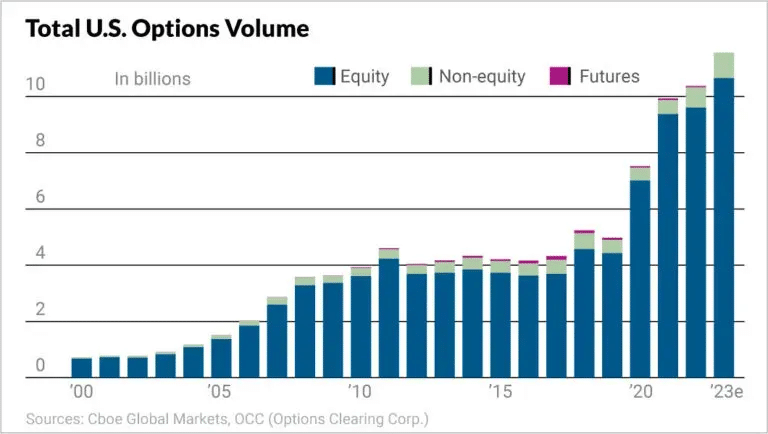
Over the last decade, the U.S. options market has experienced explosive growth, with trading volumes significantly outpacing growth in futures trading. This surge sets new records annually, fueled by increased retail participation and the popularity of short-dated options contracts (especially 0DTE – zero days to expiration).
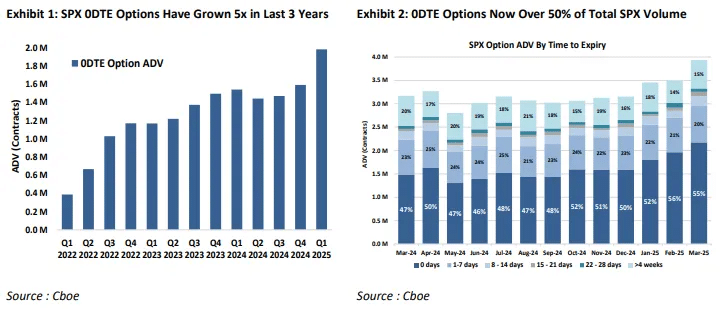
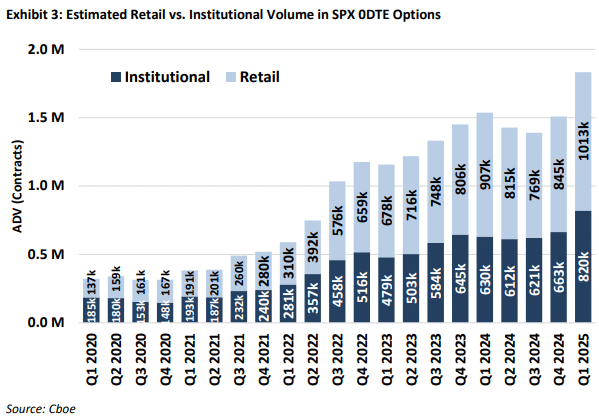
What’s crucial to understand is that this shift has fundamentally altered how markets move. Traditionally, options were viewed as derivatives (tools to hedge) that followed stock prices. But today, we’re witnessing the reverse: options are increasingly used as the primary vehicle for speculation, and this speculative activity now drives the movement of underlying stocks.
This shift reverses the traditional dynamic—now, the options themselves often drive the prices of underlying assets, a phenomenon described as “the tail wagging the dog.”
This isn’t just theory. We see it daily in stocks like TSLA, NVDA, and AAPL, where options volume can exceed actual stock volume in notional value. When this happens, the options market becomes the primary price driver, not the other way around.
If you’re not accounting for this in your trading strategy, you’re missing half the picture.
This transformation in market behavior influences markets in two critical ways:
The ongoing battle between call buyers (who speculate on price increases) and put buyers (who bet on price decreases) throughout the options chain significantly impacts market structure and price action. Understanding these dynamics provides valuable clues about potential future price paths:
These concepts apply to both intraday timeframes (SPX 0DTE trading) and single stock swing trades (considering all expirations).
The expanded role of options increases the influence of Market Makers/Dealers (MM/D). These entities react to options trade flow and can exert significant buying and selling pressures as they adjust positions in response to call and put speculator activities.
Understanding this tug-of-war between call and put speculators, plus identifying crucial market levels where MM/D actions become inevitable, forms the core of effective options market analysis.
Without tools to see and understand these dynamics, you’re essentially trading blind to the forces that increasingly drive today’s markets.
As options increasingly influence price movements, three specific challenges have emerged for today’s traders:
Traditional technical analysis tools—moving averages, support/resistance, chart patterns—were designed for markets where price was the primary indicator of future movement. They weren’t built to account for massive options positioning influence.
This creates a significant blind spot. You might nail your technical analysis, but if you can’t see what’s happening “under the hood” and how options influence structure and price action, you’re missing critical forces that will impact price.
Example scenario: You find what looks like a perfect setup—clean consolidation, increasing volume, textbook chart pattern—only to watch the stock immediately reverse after hitting a specific price level or chop sideways for weeks.
This frequently happens when large concentrations of call options at specific strike prices create natural selling pressure as traders monetize profitable positions, or when call speculators suddenly exit while put speculators simultaneously step in—dynamics completely invisible on traditional price charts.
If you’ve ever opened a full options chain, you know how overwhelming it can be. Hundreds of strikes, multiple expirations, Greeks that change by the second—it’s information overload.
Standard options analysis tools often add confusion by bombarding you with more data without clear guidance on what actually matters for trading decisions.
Even traders who recognize options data importance often struggle to integrate it into a cohesive trading strategy.
Common questions include:
Without a systematic framework, traders are left guessing about current market environment and making decisions based on incomplete information.
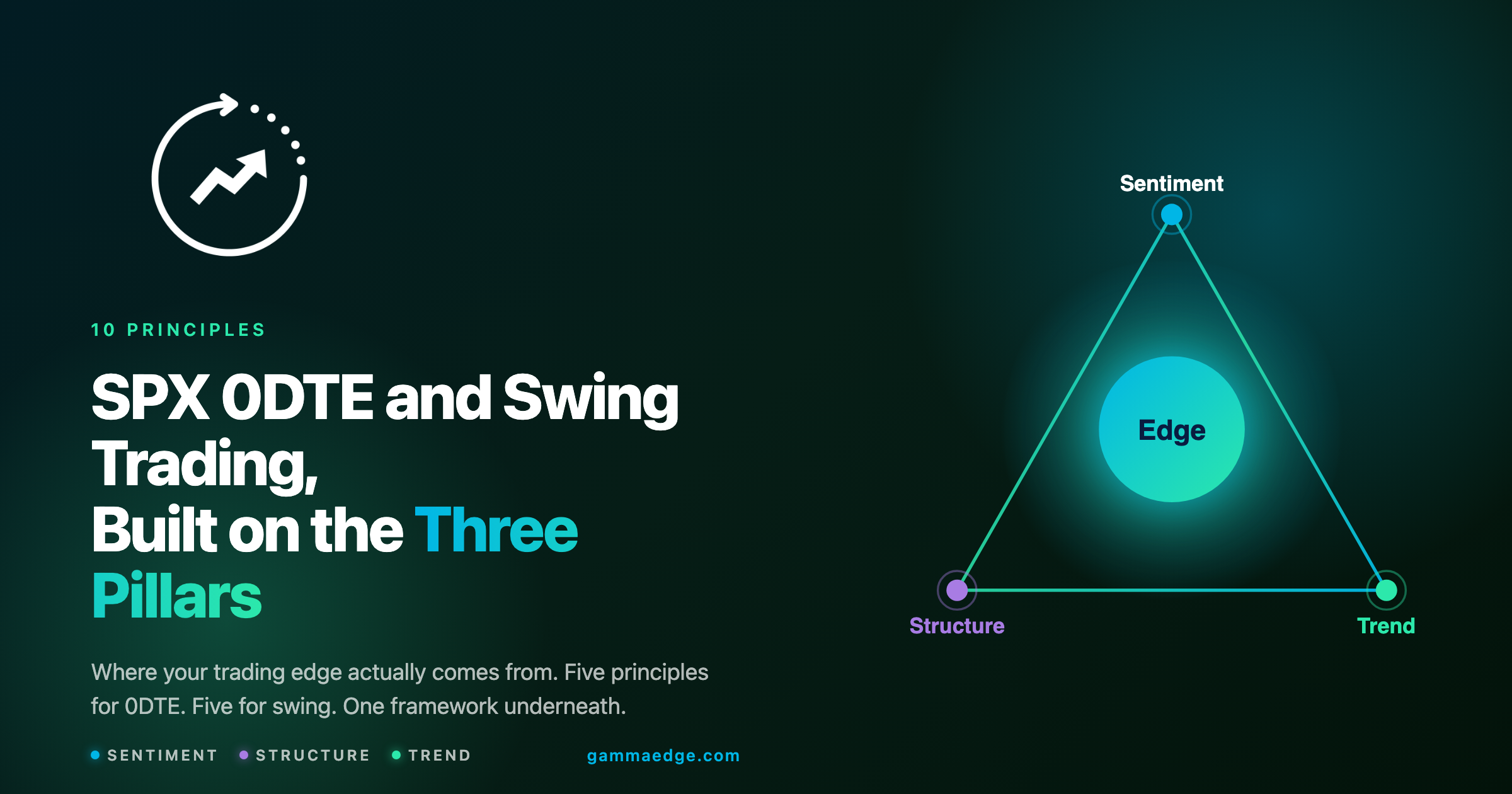
After years of observing how options influence price movement, we’ve developed a three-pillar framework that simplifies complex dynamics into actionable insights for your trading system.
What it is: Market structure refers to key price levels where market behavior changes due to options positioning. These aren’t random technical levels—they’re derived directly from the options market and represent points where dealer hedging behavior fundamentally shifts.
Why it matters: Understanding structure gives you precise levels for entries, exits, and profit targets that are invisible to traders using conventional analysis.
Key components:
Trading application: Instead of guessing where to enter or exit, you’ll know exactly which levels matter most and why. For example, when trading AAPL with a bullish bias, analysis might show PTrans at $175. Once price breaks above that level, you typically see acceleration as dealer hedging creates buying pressure, with +GEX at $180 and COI at $185 providing clear profit targets.

What it is: Sentiment analysis measures the ongoing battle between call and put speculators in the options market. It reveals who’s winning and whether their advantage is growing or shrinking.
Why it matters: By understanding sentiment, you gain insight into directional bias and conviction that isn’t visible through price action alone.
Key tools:
Trading application: These tools help you understand whether bulls or bears are gaining strength—often before that strength becomes apparent in price. A declining GEX Ratio often precedes significant price weakness, giving early warning of potential reversals.
What it is: Trend analysis confirms direction through actual buying and selling pressure in the market, not just technical indicators.
Why it matters: This ensures you’re trading with the market’s real momentum rather than fighting against the tide.
Key tools:
Trading application: By aligning trades with prevailing market flow, you significantly increase probability of success. These tools help distinguish between choppy environments where capital protection is paramount versus trending environments where you want to press your advantage.
The beauty of this framework is its adaptability across different trading styles:
If you’re holding positions for days or weeks, options market analysis helps you:
For intraday SPX traders, this approach provides:
The methodology scales across timeframes from intraday to multi-week positions, giving you flexibility based on your trading style and objectives.
Here’s what you need to understand about today’s markets:
Remember, trading with options market analysis isn’t about adding complexity—it’s about simplifying the market into actionable information that gives you an edge in today’s options-driven environment.
Understanding how options drive stock prices and having the right tools to analyze market structure, sentiment, and trend can transform your trading results. The hidden forces driving price action are no longer hidden when you know where to look.
Ready to see the market with new clarity? The next step is understanding how to implement these concepts in your specific trading strategy.