%201.avif)


Iron Condor Strategy: Master Massive SPX Structures for Consistent Trading Profits
.png)
Taylor Drake
.png)
December 12,2025
.png)
15mins read

Ever watched the market get stuck in a tight range all day, grinding sideways while your directional trades get chopped up? What if there was a way to not just survive these conditions, but actually profit from them?
That’s exactly what massive iron condor positions can show you – and more importantly, how to trade around them effectively.
An iron condor strategy involves selling both a call spread and a put spread with the same expiration, creating a position that profits from range-bound price action. But when these structures appear in massive size – what we call “Captain Condor” – they don’t just influence the market, they dominate it.
Today, we’re breaking down everything you need to know about iron condor strategies, from the basics to how enormous positions create predictable trading opportunities in SPX options.
An iron condor is an options strategy that combines four different strikes into one position:
Think of it like placing “goal posts” around where you expect the stock to trade. The iron condor strategy profits when price stays between your two short strikes (the “goal posts”) and loses money if price moves outside this range.
Here’s how iron condor profit and loss works:
Maximum Profit: Occurs when the stock closes between your two short strikes at expiration. You keep the entire premium collected.
Maximum Loss: Happens when the stock moves significantly beyond either wing. Your loss is limited to the width of the spread minus the premium collected.
Breakeven Points: Your short strikes plus/minus the net premium collected.
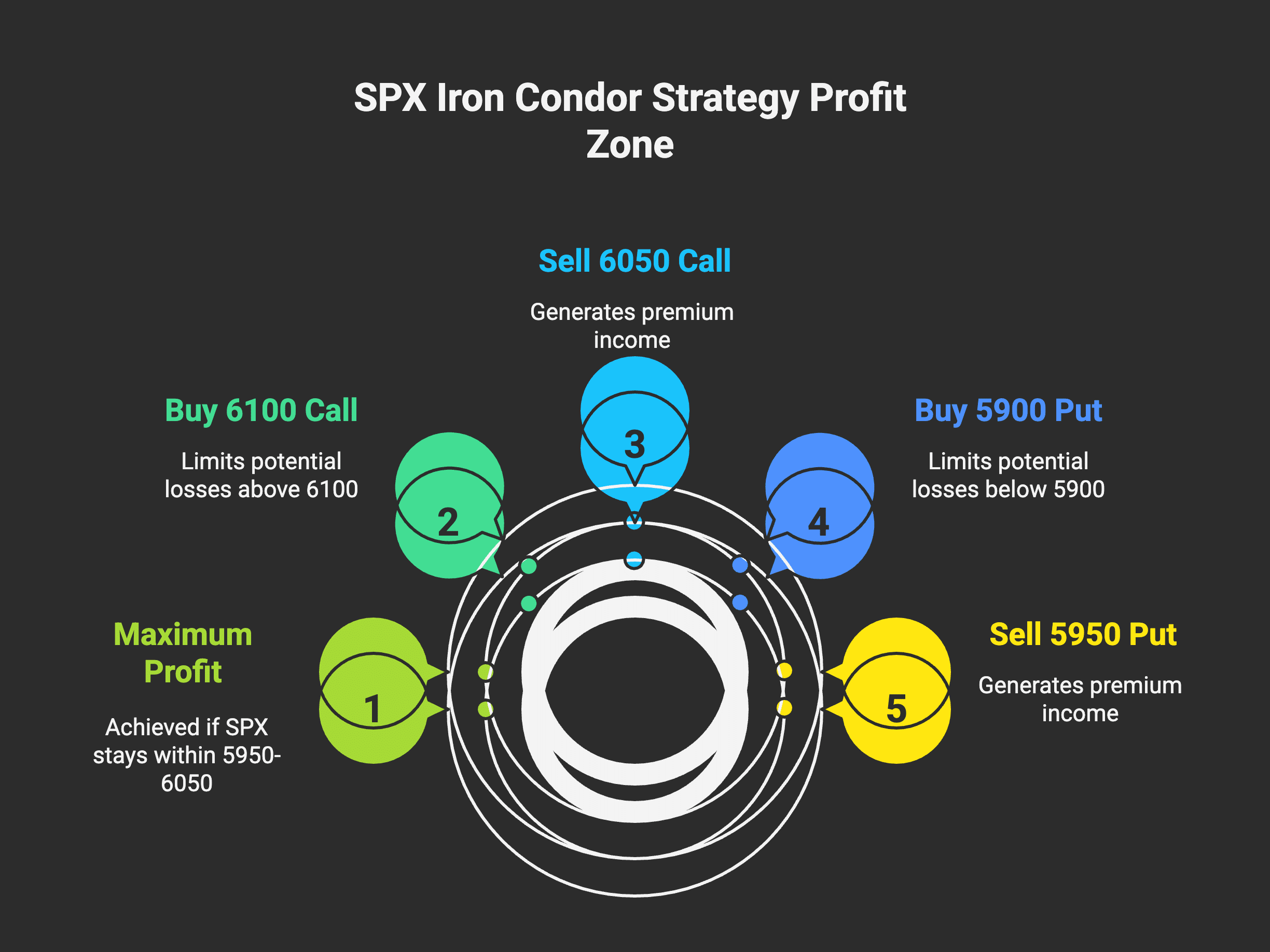
For example, if SPX is trading at 6000:
Your profit zone is 5950-6050, with maximum profit of $15 if SPX stays in this range.
While individual traders might place small iron condor strategies, institutional players sometimes create enormous positions that can exceed 25,000-30,000 contracts per leg. These “Captain Condor” structures are large enough to create their own gravitational effects on SPX price action.
When these huge iron condor positions appear in SPX options, they fundamentally alter how price behaves:
Range Creation: The massive short strikes act like magnets, pulling price toward the profit zone of the iron condor structure.
Acceleration Zones: Breaking through the wings creates momentum as thousands of options shift from out-of-the-money to in-the-money simultaneously.
Volume Impact: The sheer size means that normal technical analysis often breaks down, as options positioning creates forces that traditional charts can’t account for.
We identify these massive iron condor positions through our options analysis tools, looking for:
When we spot these in our morning analysis, it completely changes our trading approach for the session.
Massive iron condor structures create three distinct trading environments, each requiring different approaches:
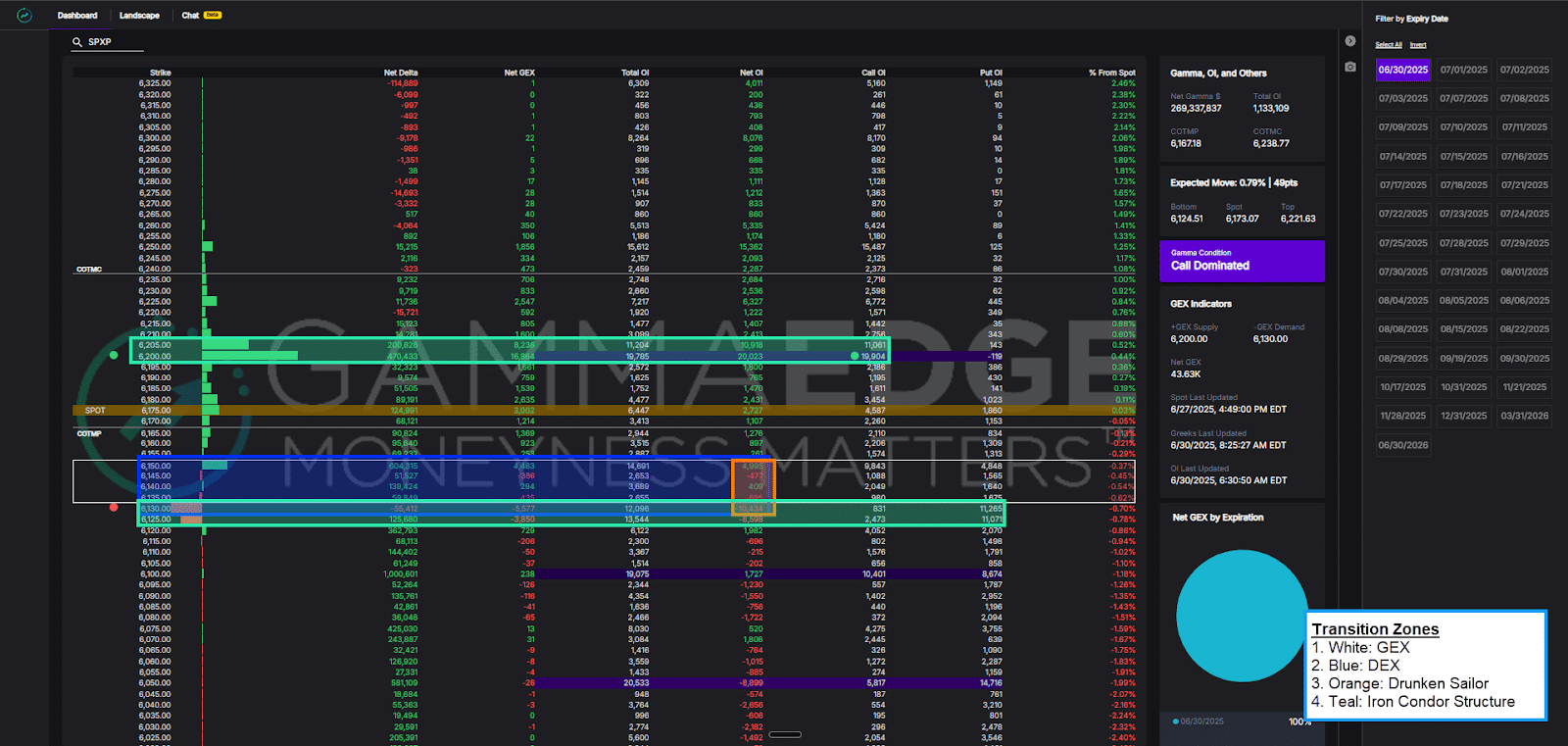
When SPX price is trapped between the short strikes of a massive iron condor:
What to Expect:
Trading Approach:
When price clears the upper short strike of the iron condor:
What Happens:
Trading Approach:
When price falls through the lower short strike:
What Happens:
Trading Approach:
Successful iron condor trading requires understanding how to manage risk in each regime:
Iron condor structures create different time decay effects:
When we identify massive iron condor structures in our analysis:
Inside the Iron Condor Range:
Outside the Iron Condor Range:
Use our intraday volume analysis to:
The maximum profit equals the net premium collected when entering the position. This occurs when the underlying closes between your two short strikes at expiration.
Iron condors work best in range-bound markets with low volatility. They’re ideal when you expect the underlying to trade sideways rather than make large directional moves.
Iron condors offer limited profit potential but also limited risk, making them more conservative than naked options selling but less profitable than successful directional trades.
If price moves beyond your short strikes, you’ll start losing money. Your maximum loss is the width of the spread minus premium collected, but you can close early to limit losses.
Common adjustments include closing the untested side, rolling strikes, or converting to different strategies. However, many traders prefer to close losing positions rather than adjust.
Massive iron condor positions create unique gamma effects:
The time decay (charm) effects vary by zone:
Iron condor structures create distinct market regimes that require different trading approaches. The key is recognizing which regime you’re in and adapting your strategy accordingly.
When we identify these massive structures in our morning analysis, we’re not just pointing out interesting market trivia – we’re giving you the roadmap for how price is likely to behave throughout the session. Understanding these dynamics can mean the difference between fighting against invisible forces and trading with the structural flow.
Remember: these structures don’t predict exact price movements, but they do reveal the zones where different types of behavior are most likely to occur. Use this knowledge to position yourself advantageously rather than getting caught off guard by seemingly random price action.
Ready to master iron condor analysis and other advanced options strategies? Join thousands of traders who use our comprehensive framework to understand market structure and improve their trading results.